![duel_logotype-1.png]](https://info.duel.tech/hs-fs/hubfs/duel_logotype-1.png?height=37&name=duel_logotype-1.png)
Overview
How to Set Up and Use Labels
Group Labels
Dynamic Labels
Custom Labels
Overview
Labels provide an additional way to categorize and organize Advocates into specific cohorts. They can be used for insights, challenge distribution, and targeted notifications, allowing for more refined advocate management.
An advocate can only be a member of a single group however they can be a part of multiple labels.
Labels can be combined to create Segments. For more details, see the further reading below.
📚 Segments
How to Set Up and Use Labels
-
Navigate to Advocates > Segmentation > Labels.
-
Click ‘Create’, select a Label type, and assign a name and description.
-
Define parameters (for Dynamic & Group) or manually select Advocates (for Custom).
-
Save the label – an estimate of the total Advocates included will be displayed.
-
Labels can now be applied to challenges, notifications or insights.
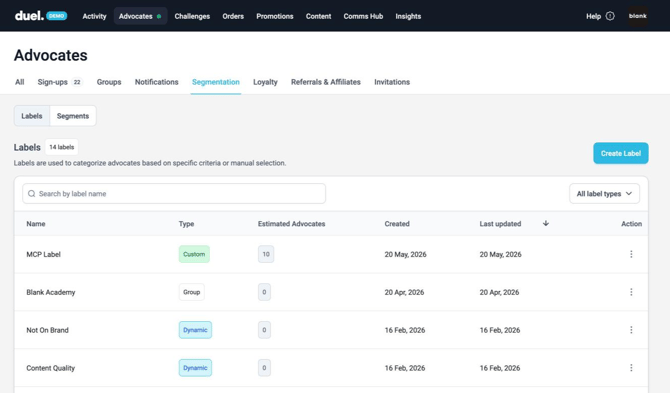
📌 Note: The Duel app may require a refresh for new Labels to appear in the dashboard or challenge builder.
Label Types
Group
Group Labels enable you to combine multiple groups or tiers under a single label. This is useful for challenge distribution and reporting, providing a streamlined way to manage and analyse different Advocate segments.
Example Use Case
A program operates in four different region based groups. By applying a Group Label, all four can be combined into a single cohort for insights and reporting.
Dynamic
This label type allows brands to dynamically separate advocates based on a range of data points.
- Performance - Identify advocates by metrics (e.g., revenue, points), segments (e.g., top 10%), and timeframes (e.g., last 30 days).
- Profile - Categorize advocates by attributes like location, social platforms, follower count, and custom fields.
Profile labels by address
To label advocates by where they live, choose Profile as the type, then Address as the subject, and pick the Address Field: Country, City or State / Region. Then choose a Value from the list, which shows the values already in your advocates' addresses.
The label matches that exact text, so similar entries count as different values. For example, "New York" and "New York City" are separate options. If an advocate changes their address in the portal, their label updates to match.
Some example dynamic properties
- Custom Field - Filter advocates based on the custom field information they have provided on their application or challenge submissions.
- Generated Revenue – Fixed or variable ranges, such as the top 10% of revenue generators over the past 7 days.
- Social Post Reactions & Comments – Segment Advocates based on engagement levels.
- Points – Use loyalty or engagement points as a segmentation factor.
- Location (Country & City) – Direct specific challenges or campaigns to Advocates in certain regions.
Custom
Custom Labels provide full control over segmentation, allowing brands to create bespoke groups without predefined rules. Unlike Dynamic Labels, Custom Labels do not update automatically - you add advocates yourself (one at a time or from a CSV) and remove them one at a time.
Custom labels currently have a cap of 500 advocates.
Example Use Case
A brand wants to reward its top 50 revenue-generating Advocates with a personalized incentive. Instead of relying on dynamic segmentation, a Custom Label ensures only those handpicked Advocates are included in the campaign.
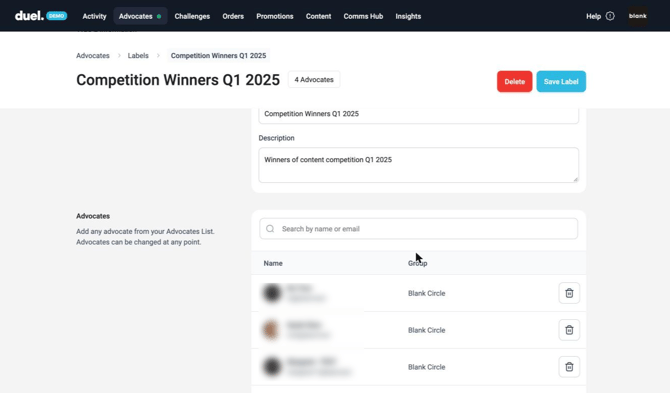
Add advocates to a custom label from a CSV
Instead of adding advocates one at a time, you can upload a list, for example competition winners, a VIP list from an event, or advocates your team spotted on social.
- Go to Advocates › Segmentation › Labels and open (or create) a Custom label.
- Under the list of advocates, click Add › Upload CSV.
- Upload a CSV with one column of advocate emails or advocate IDs.
- Check the preview, then click Add N advocates.
- Click Save Label.
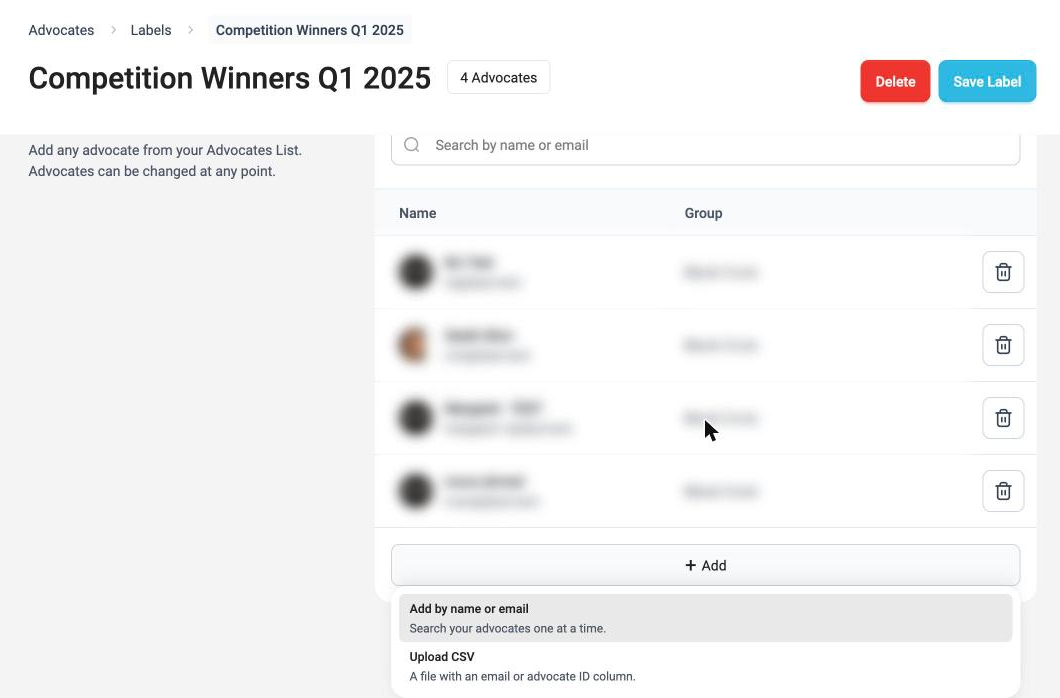
🚨 Nothing is saved until you click Save Label. If you leave the page after confirming the preview, the advocates aren't added.
Before anything is added, the preview shows:
| In the preview | What it means |
|---|---|
| Unique emails or IDs | Rows in your file, with duplicates removed. |
| Matched advocates | Rows that matched an accepted advocate in your program. |
| Already in label | Matched advocates who are already in the label. |
| Not found | Rows that didn't match. You can expand this to see which ones. |
| Over the limit | Shown only if the file would take the label past its limit: how many matched advocates won't fit. |
Good to know
- Custom labels hold up to 500 advocates. If your file would go past that, only advocates up to the limit are added.
- Only advocates already accepted into your program match. Pending applicants, and anyone from another program, show as Not found.
- No header row is needed. If your file has one, it shows as one Not found row, which you can ignore.
- Email matching ignores capital letters and extra spaces.
- Upload CSV is for custom labels only, and it only adds advocates. To remove someone, use the bin icon next to them in the list.
💡 Working in Excel? Export your sheet as a CSV first. If you pick Add by name or email and then want to upload a CSV instead, reload the page to bring back the Add menu.