![duel_logotype-1.png]](https://info.duel.tech/hs-fs/hubfs/duel_logotype-1.png?height=37&name=duel_logotype-1.png)
Step-by-Step Guide
Video Walkthroughs
Form Elements
Challenge Examples
If you need a refresher on what challenges are and how they work, see: Challenge Overview
Step-by-Step Guide
1. Access the Challenge Builder
-
Go to Challenges in your Duel dashboard.
-
Click Create Challenge.
2. Challenge Details
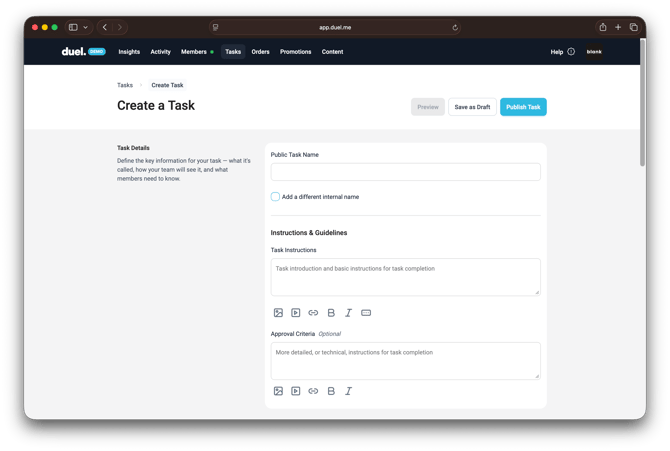
Public Challenge Name (Required): This is the challenge title visible to advocates and acts as the primary call-to-action.
Internal Name (Optional): Enable “Add a different internal name” to create an admin-only label. Useful for internal organisation and reporting.
3. Instructions & Guidelines
Challenge Instructions: This is the main description advocates see when they open the challenge. Use this field to clearly outline the completion steps and highlight any key requirements they must follow to successfully submit the challenge.
Formatting options include:
Approval Criteria (Optional): Used for additional or standardised guidance across multiple challenges. These details are hidden by default and can be expanded by advocates using the “Show more” toggle.
4. Challenge Steps
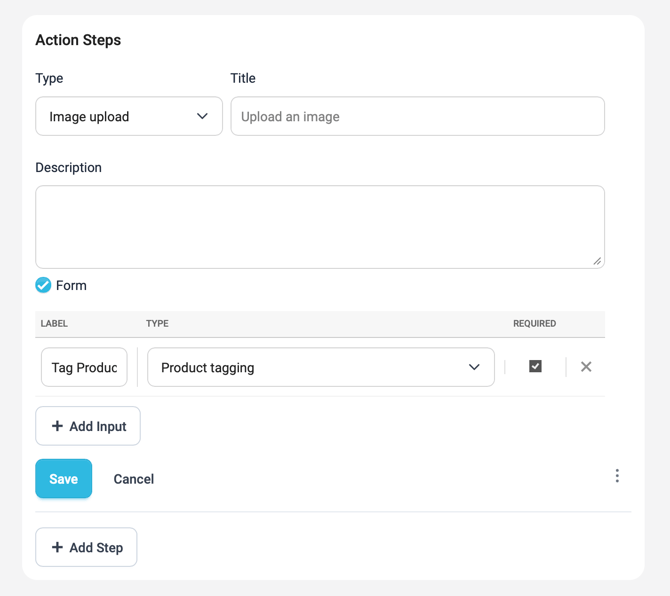
Every challenge must include at least one action step. To add a step, click Add Step to create a new step block. Each step must then be fully configured and saved individually before publishing the challenge.
Step Type: Select the action advocates must complete. See all available action steps here, and a full breakdown of each step type here.
Step Description: Provide additional guidance specific to that action, helping advocates clearly understand what is required for the specific action step.
Moderation Settings: Available via the three-dot menu on each action step. Depending on the step type, you can configure moderation behaviour.
Auto Moderate: Automatically approves submissions. Best suited for low-risk or low-value challenges.
Require Moderation to Progress: Prevents advocates from moving to the next step until their submission has been approved. Useful for sequential flows or quality-controlled campaigns.
Form (Optional): For Image Upload or Social Post step types, enable Form to collect structured data alongside the submission, such as image tagging or other required information.
5. Completion Settings
Define what happens after an advocate completes the challenge.
Completion Message: Displayed once all required steps have been completed. Use this to thank the advocate, confirm reward details, and outline any relevant next steps.
If a promo code reward is attached, include clear and specific information here, as this message is shown alongside the reward. For example: “£50 reward voucher valid on full-price items only.”
Promo Code Reward (Optional): Click Configure to attach a promo code reward to challenge completion and automatically distribute the reward upon approval. For full configuration guidance, see: Promo Codes.
Allow Multiple Completions: Enables repeat participation and is ideal for recurring or ongoing engagement campaigns.
6. Audience
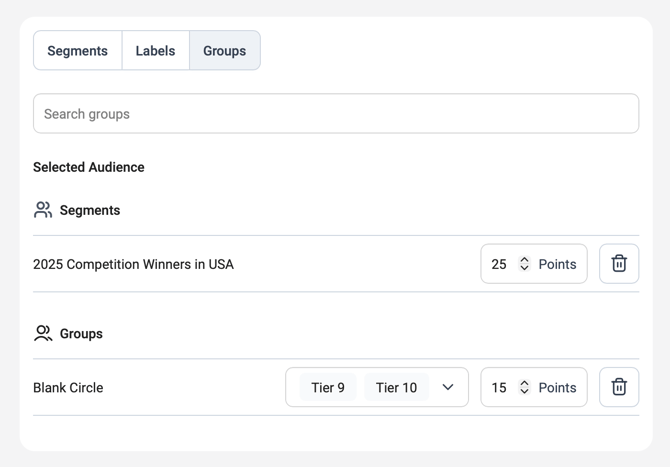
Control which advocates can access and complete the challenge. At least one audience rule must be defined before publishing.
Target By: Select the relevant Segments, Labels, or Groups to determine which advocates can view and complete the challenge.
For each selected audience rule, you can assign reward points
6. Visibility & Promotion
List This Challenge Publicly: When enabled, the challenge appears in the main challenge listing for eligible advocates. If disabled, the challenge is hidden from the public listing and can only be accessed via a direct link. Audience targeting rules still apply.
Pin to Top (Optional): Keeps the challenge fixed at the top of the challenge listing, even after it has been opened by an advocate.
Promotion Rank (Optional): Assign a priority value to control the challenge’s position in the listing. Higher numbers appear above lower numbers.
Icons / Banner Tags (Optional): Apply tags to attach specific visual indicators, such as icons or banners, to the challenge.
7. Scheduling (optional)
Start Date: Controls when the challenge becomes available. Required if an End Date is set.
End Date: Defines when the challenge expires and cannot be set without a Start Date.
Scheduled challenges display the remaining time in the advocate portal, helping to drive urgency and engagement.
7. Preview, Save & Publish
At the top of the page:
-
Preview – See how the challenge appears to advocates
-
Save as Draft – Save without publishing
-
Publish Challenge – Make it live to the selected audience
Challenges will only be available to publish or draft once all required fields are completed, at least one action step is added, and a target audience is defined.
Video Walkthrough
Form Elements
Form elements are essential components that allow us to store and interact with user input in a variety of ways. They can be set up within a challenge or as part of the signup/application form.
- See dedicated article for more detailed information here.
Challenge Examples
See our Challenge Index for a range of challenge examples